



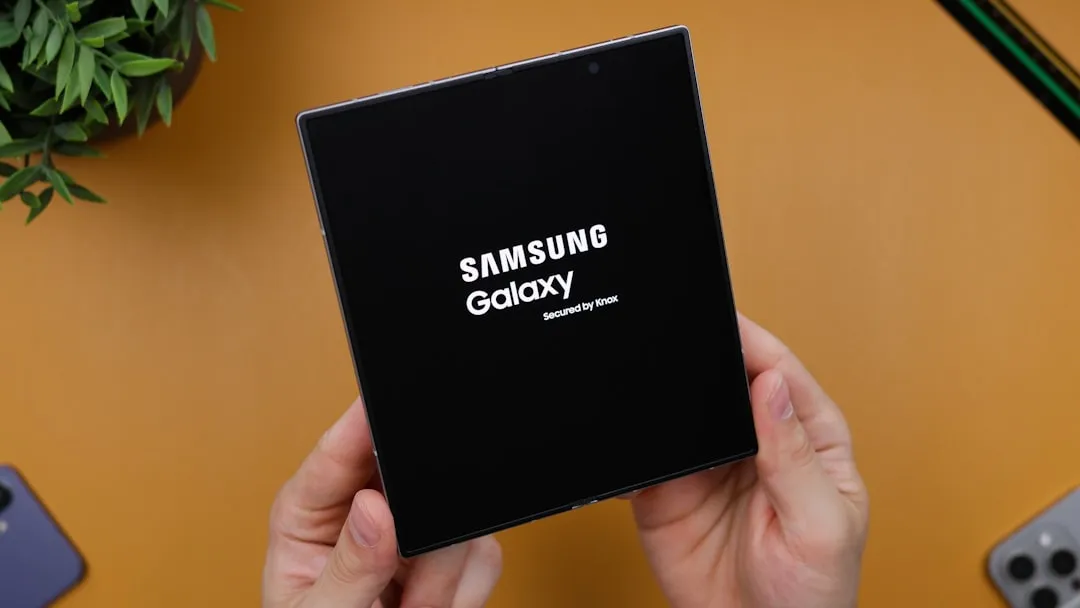
When Samsung's Galaxy Z TriFold launches with its innovative three-battery design, most users will be content with the standard configuration. But for the truly adventurous DIY enthusiast, those three separate battery compartments present an irresistible opportunity for extreme modification. Imagine transforming Samsung's upcoming tri-fold device into a 9,600mAh powerhouse that could potentially run for days on a single charge.
The concept isn't as far-fetched as it might sound. Patent documentation reveals that the device will feature three distinct battery compartments, each housing cells of different sizes to accommodate the complex internal layout. The smallest battery sits in the camera segment, the largest occupies the central fold, and a medium-sized cell powers the cover display section. This segmented approach, while designed for Samsung's specific capacity targets, creates unique possibilities for modification.
Why the TriFold's design is perfect for battery hacking
The Galaxy Z TriFold's architecture represents a departure from traditional smartphone battery design in ways that could benefit ambitious modders. Patent images show that each of the three segments contains a rectangular battery cell, with the camera housing featuring the smallest cell due to space constraints from the triple camera system.
What makes this particularly compelling is the distributed power management approach. Unlike conventional smartphones where a single large battery must fit within tight constraints, the TriFold's segmented design means each compartment can potentially accommodate larger cells without affecting the others. The overall capacity is expected to exceed 5,000mAh in Samsung's stock configuration, but the physical space available suggests much higher capacities could be achievable.
Here's the key insight: the thermal and structural challenges that normally limit battery modifications are distributed across three separate compartments. Patent documentation reveals a vapor chamber cooling system positioned centrally, designed to handle the heat from the Snapdragon 8 Elite Gen 5 processor. This cooling infrastructure could potentially support the additional thermal load from higher-capacity batteries, assuming proper heat distribution between all three segments.
The distributed weight approach becomes crucial when considering nearly doubling the battery capacity. Rather than cramming a massive single battery into one section, the three-segment design naturally spreads the additional mass. The device maintains an extremely slim profile when completely unfolded, which provides the foundation for such ambitious modifications without compromising the device's balance.
Each segment offers different modification opportunities based on available space and component constraints. The central segment, housing the largest stock battery, would be the primary target for capacity upgrades. The cover display segment provides moderate expansion potential, while the camera segment presents the biggest challenge due to space limitations from the imaging hardware.
The technical challenges of triple battery modification
Here's where things get significantly more complex—modifying the TriFold's battery system isn't simply about swapping in larger cells. The real challenge lies in the sophisticated battery management system required to coordinate three separate power sources safely. Protection circuits serve as electronic guardians, monitoring voltage, current, and temperature to prevent dangerous conditions like thermal runaway.
Cell balancing becomes particularly critical when dealing with modified high-capacity systems. In multi-cell battery configurations, balancing ensures all cells charge and discharge evenly, preventing individual cells from overcharging or deep discharging. Without proper balancing, some cells may reach dangerous voltage levels while others remain underutilized—a recipe for disaster with nearly 10,000mAh of capacity.
Samsung's original system likely uses sophisticated algorithms to manage the three batteries as a unified power source, with real-time monitoring of each cell's state. A modification would need to either work within Samsung's existing management system (nearly impossible without access to proprietary code) or implement an entirely new BMS capable of handling the increased capacity safely.
The thermal management challenges multiply exponentially with higher capacity cells. Protection circuits monitor temperature and can reduce charging current or disconnect batteries when overheating is detected. A 9,600mAh modification would generate significantly more heat during charging and heavy usage, potentially overwhelming the vapor chamber cooling system.
Each battery segment would need individual thermal monitoring and protection systems working in concert. The central vapor chamber cooling might handle the primary thermal load, but the outer segments could develop hot spots that the original cooling design never anticipated. This creates a cascading complexity where thermal management, cell balancing, and protection circuits all need to work together in ways Samsung never intended.
The electrical integration adds another layer of technical complexity. Samsung's power management system was designed for specific voltage curves and charging characteristics. Higher-capacity cells might have different internal resistance and discharge patterns, potentially confusing the device's power management algorithms and leading to inaccurate battery percentage readings or charging issues.
Silicon-carbon batteries: the key to extreme capacity
Achieving 9,600mAh capacity in the TriFold's form factor would almost certainly require silicon-carbon battery technology rather than conventional lithium-ion cells. These advanced batteries offer significantly higher energy density, potentially allowing for the dramatic capacity increase while maintaining reasonable thickness and weight.
The challenge compounds because Samsung hasn't confirmed whether the TriFold will use silicon-carbon technology in its stock configuration. This uncertainty creates both opportunity and significant risk for modders. Silicon-carbon cells have fundamentally different charging characteristics and thermal properties compared to traditional lithium-ion batteries, requiring completely compatible charging circuits and temperature management systems.
Silicon-carbon technology could actually make this extreme modification more technically feasible than it initially appears. These batteries can achieve energy densities up to 50% higher than conventional lithium-ion cells, meaning the same physical space could house substantially more capacity. However, they introduce their own complications that multiply the complexity of an already challenging modification.
The modification would need to account for the different voltage curves and charging profiles of silicon-carbon cells. Active balancing systems transfer energy between cells using inductors or capacitors, which could be more efficient than passive balancing for managing the complex charging requirements of high-capacity silicon-carbon cells across three separate compartments.
Sourcing appropriate silicon-carbon cells for such a modification presents its own challenges. These aren't consumer-available components, and matching the exact form factors needed for each of the three compartments would require custom manufacturing or significant case modifications—adding cost and complexity that puts such projects beyond most DIY enthusiasts.
The temperature characteristics of silicon-carbon batteries also differ substantially from traditional lithium-ion cells. They typically operate more efficiently at higher temperatures but can be more sensitive to thermal runaway conditions. This means the modification would require even more sophisticated thermal monitoring and protection systems than the already complex setup needed for conventional high-capacity cells.
The risks and warranty implications
Let's be absolutely clear about something—any battery modification of this magnitude comes with serious safety considerations and immediate warranty voiding. Overcharging lithium batteries can lead to thermal runaway, a dangerous condition where uncontrolled heating can cause fires or explosions. The complexity of managing three modified high-capacity cells multiplies these risks exponentially.
The structural integrity of the device becomes a major concern when dealing with such extreme modifications. Patent images show the TriFold maintains an extremely slim profile when unfolded, which could be compromised by thicker battery cells. The delicate hinge mechanisms that enable the tri-fold operation might not accommodate the additional bulk or weight of higher-capacity batteries, potentially leading to mechanical failure.
Beyond immediate safety concerns, such modifications would instantly void Samsung's warranty and create significant legal liability issues. The device's original safety certifications would no longer apply, and any damage or injury resulting from the modification could have serious legal and financial consequences. Insurance coverage for modified devices is typically excluded, leaving modders fully liable for any problems.
The practical considerations of performing such a modification are equally daunting. The TriFold's construction involves complex ribbon cables, precision-fitted components, and proprietary connectors. Disassembling the device without damaging critical components would require specialized tools and considerable expertise. The device uses two hinge mechanisms to keep all three pieces together, adding mechanical complexity that makes teardown and reassembly extremely challenging.
What's particularly concerning about this type of modification are the emergency response implications. If something goes wrong with a high-capacity modified battery system, standard fire suppression methods might not be adequate. Lithium battery fires require special handling and can reignite even after appearing extinguished, creating ongoing safety hazards.
The legal implications extend far beyond warranty voiding. Depending on your location, modifying battery systems might violate regulations about electrical safety standards. Travel becomes problematic—airport security and airline policies would likely prohibit such a device due to the non-standard, high-capacity battery configuration that exceeds typical safety limits.
What this means for the future of foldable devices
While a 9,600mAh TriFold modification represents an extreme example, it highlights important evolutionary trends in foldable device development. The TriFold's expected launch toward the end of this month will demonstrate whether Samsung's multi-battery approach can deliver meaningful improvements over traditional single-battery designs in real-world applications.
The segmented battery architecture could fundamentally influence future foldable designs across the industry. Rather than continuing to struggle with fitting ever-larger single batteries into complex foldable forms, manufacturers might embrace distributed power systems that naturally match the physical constraints of folding devices. This approach enables more efficient space utilization and superior weight distribution—key factors for foldable usability.
What's particularly intriguing is how this distributed approach might scale to even more complex folding patterns. If three batteries work effectively for a tri-fold design, we could potentially see quad-fold devices with four optimized battery compartments, or even more exotic folding configurations. The modular approach opens up design possibilities that would be impossible with traditional single-battery architectures.
Initial availability may be limited to South Korea, China, and potentially the United States, but the technical innovations demonstrated in the TriFold will likely influence Samsung's broader foldable strategy and industry standards. The lessons learned from managing three separate batteries could eventually lead to more sophisticated power management becoming standard in mainstream devices.
From an engineering perspective, the TriFold represents Samsung testing the boundaries of what's possible with distributed battery systems. The successful implementation of three-segment power management could pave the way for other distributed component architectures—imagine processing power distributed across multiple segments, or camera systems that take full advantage of unique form factor possibilities.
This distributed approach might eventually extend beyond foldables to influence conventional smartphone design, leading to more efficient thermal management and power distribution in future devices across Samsung's entire lineup.
The bottom line: impressive but impractical
A 9,600mAh Galaxy Z TriFold modification represents exactly the kind of extreme DIY project that captures imaginations while highlighting the practical boundaries of current technology. The TriFold's three-battery design creates unique modification possibilities that simply don't exist in conventional smartphones, but the safety challenges, warranty implications, and technical complexity make such projects suitable only for the most experienced hardware specialists working in controlled environments.
The real value lies in understanding how Samsung's innovative approach to foldable power management might evolve. With battery capacity expected to exceed the Galaxy S25 Ultra's levels, the TriFold already represents significant progress in foldable battery technology without requiring any dangerous modifications whatsoever.
For the vast majority of users, the stock TriFold configuration will likely provide impressive battery life while maintaining the safety and reliability that Samsung's engineering team has carefully balanced through extensive testing. The extreme modification concept serves as a fascinating thought experiment about the possibilities inherent in distributed battery architectures, even if the practical implementation remains firmly in "don't try this at home" territory.
What's genuinely exciting is that Samsung's willingness to experiment with unconventional battery layouts suggests we're just beginning to see what's possible with foldable device design. The TriFold's three-battery approach might seem complex today, but it could become the foundation for even more innovative power solutions in tomorrow's devices. The key is letting the professionals handle the engineering while we enjoy the benefits of their carefully tested innovations.








Comments
Be the first, drop a comment!